How to Properly Change Words in Essay
AI can write content for blogs, websites, social media and more.


Practical Ways to Change Words in Essay
Swapping words from a thesaurus is the weakest form of editing. To change words in an essay well, you need to know why the current word falls short: too vague, too formal, or simply repeated too often. The replacement should serve the sentence, not just differ from the original.
Start with redundancy. Most essays say the same thing twice in slightly different clothes, and cutting the second telling tightens the whole piece. If a word adds nothing, delete it rather than replace it.
Then look at your verbs. Passive constructions bury the actor and slow the sentence down, so rewording toward active voice usually makes an essay clearer and more direct. "The experiment was conducted by the team" becomes "The team ran the experiment," and the reader feels the difference.
Finally, weigh connotation. "Cheap" and "affordable" describe the same price and leave different impressions. When you change words in an essay, pick the option whose emotional shading matches your argument, because those small choices decide how persuasive the finished essay feels.
Rewrite your text in a few steps
Hand the slow writing work to the AI: blog
articles, product descriptions and more.

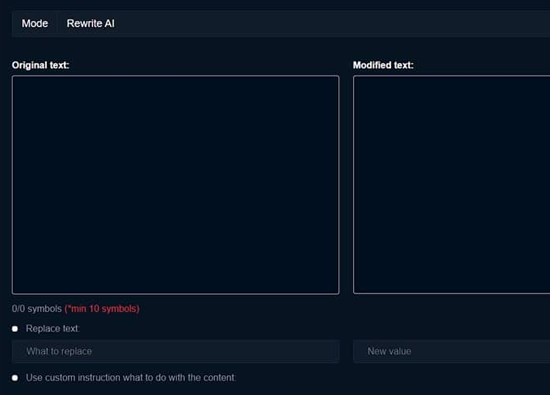
Paste the text you want rewritten, add any notes on tone or wording, and the AI gets to work.
The rewrite is ready in a few seconds. Copy it or export it wherever you need.

Paraphrasing Without Plagiarism: How to Change Words in Essay
Plagiarism can sink a grade or a career, and it is easier to commit by accident than most people think. Whenever your essay draws on someone else's work, you need to change the words honestly, which means real paraphrasing rather than light disguise.
The reliable method starts with understanding. Read the source passage until you can explain its main points from memory, then put it away and write your own explanation without looking at it. If you cannot do that, you have not understood the material yet, and no amount of word swapping will hide it.
Be careful with synonyms. Replacing a handful of words while keeping the source's sentence structure can still count as plagiarism. When you change words in an essay, rebuild the sentences too, so the structure and rhythm are yours rather than the original author's.
Citation is the last step and the one people skip. Paraphrasing changes the wording, not the ownership of the idea, so name your sources even when every sentence is your own. Proper attribution credits the original author and makes your own argument easier to trust.
Learning to change words in an essay properly takes practice, but it pays off in writing that is clearer and unmistakably yours. Paraphrase from understanding and cite what you borrowed. Those two habits hold up anywhere your essay is read.